The 50+ Hair Wellness Project · Postpartum
Postpartum Hair Loss: A Realistic Timeline and What Helps
Postpartum shedding is common, temporary, and driven by a predictable hormonal shift. Understanding the timeline — and what the research does and does not support — can help you decide whether to wait, seek advice, or consider a supplement.
A few months after giving birth, many women notice more hair than usual in the shower drain, on the pillow, or wrapped around a hairbrush. It can be alarming, especially when it follows a pregnancy during which hair often looked unusually thick and full.
The change is real, but it is also predictable. Postpartum hair loss is one of the most well-documented temporary hair changes in women, and understanding why it happens — and how long it typically lasts — can make the experience feel less like a problem to solve and more like a phase to move through.
This guide looks at what the research actually says about postpartum shedding, what a realistic timeline looks like, and where a supplement fits — or does not fit — into the picture.
1. Why postpartum hair loss happens

During pregnancy, higher levels of estrogen and progesterone keep many hair follicles in the growth phase for longer than usual. The result is often thicker, fuller hair — a change many women notice and enjoy.
After birth, hormone levels drop quickly. Follicles that were held in the growth phase shift into the resting and shedding phases at roughly the same time. This synchronized shift is why postpartum shedding can feel dramatic: it is not gradual, but concentrated over a few months.
The clinical term is telogen effluvium — a temporary increase in shedding triggered by a physiological change. It is not the same as female pattern hair loss, and it is not a sign of a health problem in most cases.
2. A realistic timeline

Postpartum shedding typically begins around two to four months after birth, peaks over the following weeks, and then gradually decreases. Most women notice significant improvement by six to twelve months postpartum, though the exact timing varies.
Several factors can influence how noticeable the shedding feels:
- Hair length. Longer hair makes shedding more visible, even when the number of hairs lost is the same.
- Pregnancy hair changes. Women who experienced the biggest pregnancy-related thickening may notice the biggest postpartum shed.
- Other stressors. Sleep deprivation, recovery from birth, and changes in nutrition can overlap with the hormonal shift.
What the timeline does not usually include is a permanent change in density. For most women, hair returns to its pre-pregnancy pattern over time.
Start with the bigger picture
Understand the different factors that can affect hair
Our companion guide looks at aging, menopause, nutrition, shedding, thinning, and everyday hair care — before any product enters the picture.
Read the Hair Wellness Guide3. What actually helps

There is no intervention that reverses postpartum shedding — because the shedding itself is a normal physiological process. What tends to help is supporting the body through the recovery period and avoiding habits that add avoidable stress to the hair:
- Eat adequately and regularly. Recovery, breastfeeding, and sleep deprivation all increase nutritional demands. Inadequate intake can compound the shedding.
- Treat hair gently. Conditioner on the lengths and ends, gentle detangling on wet hair, and avoiding tight hairstyles can reduce breakage while the hair is more fragile.
- Be patient with the timeline. Most women see improvement without intervention. Rushing to a product can add cost and complexity without changing the outcome.
- Ask about iron and other nutrients. If you are breastfeeding, had significant blood loss, or are unsure about your intake, a healthcare professional can decide whether testing is appropriate.
Postpartum shedding is a phase, not a verdict. Most women recover without intervention — and the ones who need help are usually helped by assessment, not by a product alone.
4. Where a supplement fits — and where it doesn't

A supplement is not a treatment for postpartum shedding itself. Shedding is driven by hormones, not by a nutrient gap. But a supplement may be relevant in two specific situations:
- When a deficiency is confirmed or suspected. Correcting a deficiency is different from assuming that extra vitamins will help someone who already gets enough.
- When overall intake is inadequate. Recovery, breastfeeding, and disrupted routines can make it hard to meet nutritional needs through food alone.
What a supplement should not be is a substitute for assessment. If shedding is heavy, prolonged beyond twelve months, or accompanied by other symptoms (fatigue, changes in weight, scalp irritation), a healthcare professional can help identify whether something else is contributing.
5. How to evaluate a hair supplement after pregnancy
If you decide to explore a supplement, the same criteria apply here as anywhere else — but a few deserve particular attention in the postpartum period:
- Is it appropriate for breastfeeding? Some ingredients are not recommended during lactation. Check the label and, if unsure, ask a healthcare professional.
- Are the amounts disclosed? Look for the quantity of each ingredient per serving, not just a list of names or a proprietary blend with hidden amounts.
- Was the research done in postpartum women? Studies in other populations are not automatically applicable. Check who the research actually involved.
- Is safety information easy to find? Review warnings and possible interactions. Biotin, for example, is widely marketed for hair, but the U.S. National Institutes of Health notes little scientific evidence that it improves hair in people who are not deficient — and high doses can interfere with some laboratory tests, including certain thyroid tests.
- Can you understand the total cost? Check serving size, days per container, subscription terms, cancellation rules, shipping, and the cost of continuing beyond the first order.
Before you decide
Know what to look for before choosing a supplement
Our supplement evaluation guide walks through ingredient amounts, product-specific evidence, safety details, and the full purchase terms — so you can compare formulas on criteria that matter.
Read the Supplement Evaluation Guide6. When to see a professional
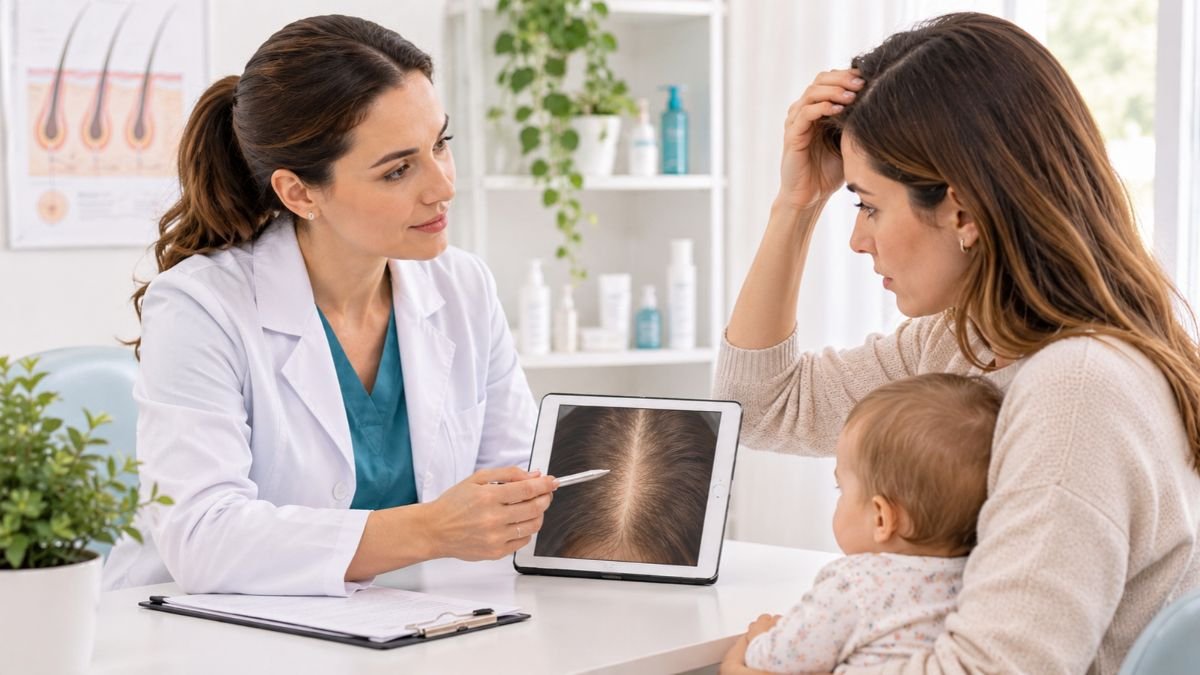
Postpartum shedding usually resolves on its own, but some signs deserve prompt assessment:
- Shedding that continues heavily beyond twelve months postpartum
- Patchy hair loss, scalp pain, or visible irritation
- Hair loss accompanied by fatigue, weight change, or other symptoms
- Thinning that follows a pattern more consistent with female pattern hair loss than with temporary shedding
A dermatologist or another qualified healthcare professional can examine the scalp and hair, review your history, and decide whether testing or treatment is appropriate.
7. A more thoughtful next step
Postpartum hair loss is common, temporary, and driven by a predictable hormonal shift. The most useful next step depends on how long the shedding has been going on, whether other symptoms are present, and whether you are breastfeeding.
Start by observing the pattern: when the shedding began, whether it is concentrated or diffuse, whether your scalp has changed, and whether anything else in your health or routine has changed. Bring those observations to a qualified healthcare professional. If you then explore products, compare them on the criteria that matter — amounts, evidence, safety, and cost.
Sources and further reading
This article is educational and draws on the following public health resources. These links are provided so readers can review the information directly.
Continue exploring
Compare formulas on criteria that matter
If you are considering a supplement, our evaluation guide helps you look beyond the front of the bottle — at amounts, evidence, safety, and total cost.
Explore the Supplement Evaluation GuideThis is an internal Lufan Lab link. No product purchase is required.
The 50+ Hair Wellness Project
Understand first. Compare carefully. Decide with confidence.
Explore the broader Hair Wellness guide for a clear overview of the factors that can influence women's hair, and the Supplement Evaluation Guide when you are ready to compare products.
Read the Hair Wellness Guide