The 50+ Hair Wellness Project · Buyer's Checklist
Hair Supplement Red Flags: A Buyer's Checklist
Some presentation choices can make a hair supplement appear more convincing than the available evidence supports. This checklist is not about naming brands — it is about the signals that deserve a closer look before you buy.
Hair supplements are a crowded market, and the language used to sell them is often more confident than the evidence behind them. That does not mean every product is misleading. It means that reading a label carefully — and knowing which signals deserve a pause — is part of making an informed decision.
This checklist is not about naming specific brands. It is about the patterns that appear across the category, and the questions worth asking before you spend money on any formula.
1. Claims that deserve a closer look

Some marketing language is a signal to slow down and read more carefully. Pause and investigate when you see:
- Promises to reverse every type of hair loss. Hair loss has many causes, and no single supplement addresses all of them.
- Guaranteed results. Real evidence does not support guarantees, because individual responses vary.
- Dramatic timelines. Claims of visible results in days, rather than weeks or months, do not match the biology of hair growth.
- "Clinically proven" without specifics. Which study? In whom? For how long? On the finished product or on individual ingredients?
- Claims that a product works for every cause of hair loss. Menopause, postpartum, GLP-1 use, thyroid conditions, and pattern hair loss are different situations.
2. Testimonials used as the main proof

Testimonials describe individual experiences. They cannot establish what caused a change or predict what another person will experience. When testimonials are the main evidence a product offers — rather than one part of a broader picture — that is a signal worth noting.
The same caution applies to before-and-after photos. Without context — dates, lighting, other treatments, whether the person was also using something else — it is difficult to know what a photo actually shows.
3. Ingredient lists that hide amounts
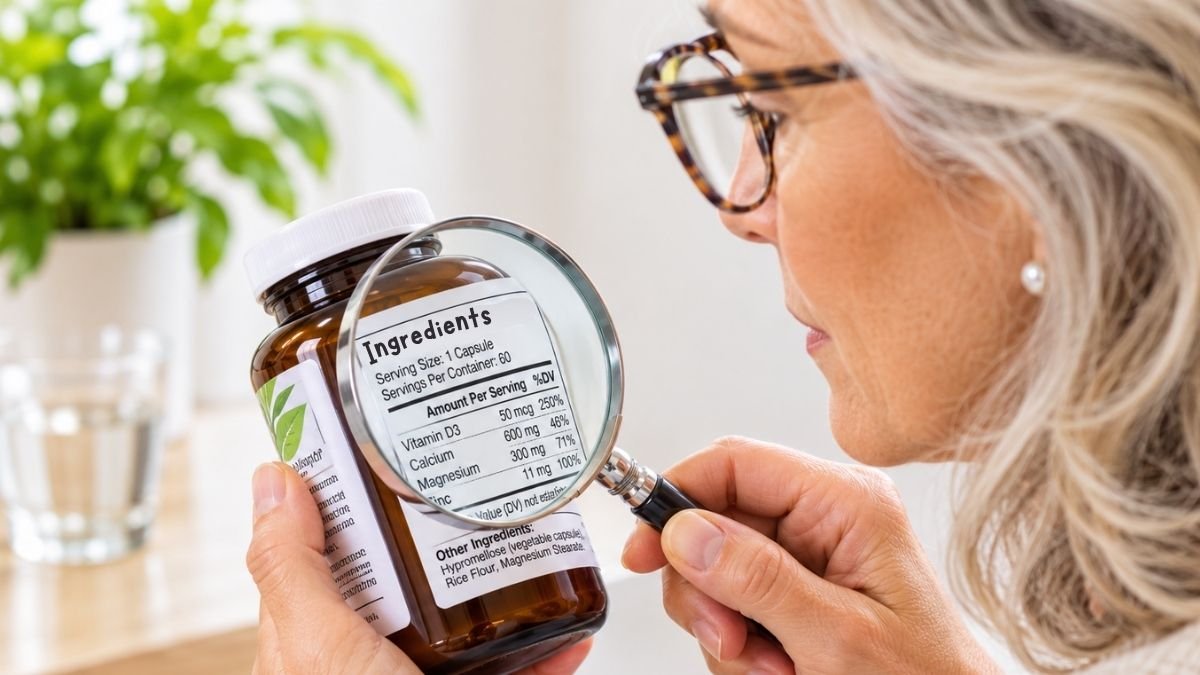
A list of ingredient names is not the same as a disclosure of how much of each ingredient a serving contains. When amounts are hidden in a "proprietary blend" or omitted entirely, it is difficult to compare the formula with published research on individual ingredients.
This matters for several reasons:
- Dose matters. Many ingredients are studied at specific amounts. A formula that includes an ingredient at a fraction of the studied dose may not produce the same effect.
- Ingredient lists can be marketing. A long list of familiar names can look impressive without telling you whether the amounts are meaningful.
- Comparisons become impossible. Without amounts, you cannot compare two formulas on the basis of what they actually contain.
If a formula cannot tell you how much of each ingredient it contains, it is asking you to trust the label rather than read it.
Start with the bigger picture
Understand the different factors that can affect hair
Our companion guide looks at aging, menopause, nutrition, shedding, thinning, and everyday hair care — before any product enters the picture.
Read the Hair Wellness Guide4. Urgent purchase pressure

Some sales pages make it difficult to review subscription or refund terms before buying. Countdown timers, "limited stock" messages, and pop-ups that interrupt the checkout process can create a sense of urgency that does not serve the buyer.
Before you buy, take time to review:
- The subscription terms — how often you will be charged, and how to cancel
- The refund policy — what is covered, what is not, and how long the process takes
- The shipping terms — where the product ships from, how long it takes, and what happens if it is delayed
- The total cost beyond the first order
5. Safety information that is hard to find

A formula that does not make its safety information easy to find is asking you to make a decision without the information you need. Look for:
- Warnings about interactions with medications
- Guidance on who should not use the product (pregnant or breastfeeding women, children, people with certain conditions)
- Information about laboratory test interference, where relevant (biotin is a well-known example)
- Clear serving instructions
If these details are not easy to find, that is a signal worth noting.
6. A practical checklist
Before you buy a hair supplement, ask:
- Are the amounts disclosed? For every ingredient, not just the ones that appear prominently on the label.
- What evidence supports the finished formula? Not just individual ingredients — the product as a whole.
- Were the studies done in people like me? Age, sex, life stage, and cause of hair change all matter.
- Is safety information easy to find? Warnings, interactions, and who should not use the product.
- Are the claims measured and realistic? Or do they promise guaranteed results?
- Is the total cost clear? Subscription terms, cancellation, shipping, and cost beyond the first order.
- Is the product appropriate for my situation? Or am I buying it because the marketing made it feel urgent?
Before you decide
Know what to look for before choosing a supplement
Our supplement evaluation guide walks through ingredient amounts, product-specific evidence, safety details, and the full purchase terms — so you can compare formulas on criteria that matter.
Read the Supplement Evaluation Guide7. What a more careful formula looks like
This checklist is not only about what to avoid. It is also about what to look for. A more careful formula tends to:
- Disclose the amount of each ingredient per serving
- Provide references to studies that are easy to find and read
- Make claims that are measured and realistic
- Make safety information easy to find
- Present subscription and refund terms clearly
- Explain who the product is designed for — and who it is not
None of these qualities guarantees that a product will work for you. But they make it possible to make an informed decision — which is a different thing from being persuaded by a label.
Sources and further reading
This article is educational and draws on the following public health resources. These links are provided so readers can review the information directly.
Continue exploring
Compare formulas on criteria that matter
If you are considering a supplement, our evaluation guide helps you look beyond the front of the bottle — at amounts, evidence, safety, and total cost.
Explore the Supplement Evaluation GuideThis is an internal Lufan Lab link. No product purchase is required.
The 50+ Hair Wellness Project
Understand first. Compare carefully. Decide with confidence.
Explore the broader Hair Wellness guide for a clear overview of the factors that can influence women's hair, and the Supplement Evaluation Guide when you are ready to compare products.
Read the Hair Wellness Guide